Netanyahu secretly meets with Arab Muslim leader of Sudan to discuss normalization of relations. Dramatic breakthrough with key former enemy. Here’s what we know so far.

Sudan-Netanyahu

(Jerusalem, Israel) — On September 1, 1967, soon after the Six Day War, Arab leaders gathered in Khartoum, Sudan, and issued their infamous “three no’s” declaration.

  1. No peace with Israel
  2. No negotiations with Israel
  3. No recognition of Israel

How rapidly the world is now changing.

Today, Israeli Prime Minister Netanyahu met secretly with the new leader of Sudan for the first time. The story is just breaking — no photos yet, and we’ll surely learn more in the days ahead — but Sudan now seems to be saying “yes” to relations with Israel.

The dramatic development underscores the point I’ve been making to reporters in recent weeks. Despite intense resistance by Palestinian leaders such as Mahmoud Abbas to peace talks with Israel, there are a growing number of leaders in the Arab world interested in taking steps towards normalization with the Jewish state.

Here’s what we know at this hour:

  • “Dramatically improving ties with a former bitter foe, Prime Minister Benjamin Netanyahu on Monday met with the transitional leader of Sudan, Abdel Fattah al-Burhan, during a whirlwind visit to Uganda,” reported the Times of Israel. “Netanyahu and Burhan met secretly…and agreed to gradually normalize relations, a senior Israeli official [said], speaking on condition of anonymity.”
  • “In September, mere days after the new Sudanese cabinet was sworn in, newly appointed Sudanese Foreign Minister Asma Abdullah indicated that her country would be interested in establishing relations with Israel if and when the Israeli-Palestinian conflict was solved,” the Times reported.
  • “Netanyahu said that he believes that Sudan is moving in a new and positive direction and that he said so to US Secretary of State Mike Pompeo,” reported the Jerusalem Post. 
  • “Israel is hopeful that in the short term, normalization talks will eventually allow civilian planes from Israel to enter Sudanese airspace, significantly shortening flight times to areas such as South Africa and other regions,” the Post added.

The meeting occurred in Kampala, Uganda, where Netanyahu was meeting with that African country’s Evangelical Christian President Yoweri Museveni. The two discussed improvement in Israeli-Ugandan relations, including the possibility that Uganda will open an embassy in Jerusalem.

What made the trip particularly poignant was that Netanyahu’s older brother, Yoni, was killed in Entebbe in the 1970s while helping the IDF rescue Israelis who’s been taken hostage by terrorists.

Developing…..

(photo: Netanyahu on the right, and Abdel Fattah al-Burhan on the left)

—————————

—————————

____________________

SPECIAL SALE: #ThePersianGamble is only $1.59 on Amazon Kindle — but just for today. Its premise: “What if Iran uses the $150 billion that President Obama gave them to secretly buy a half-dozen nuclear warheads from North Korea?”

PersianGamble-small

The sale on The Persian Gamble is just for today — Sunday — so please order now by clicking here.

While you’re at it, be sure to pre-order the hardcover edition of The Jerusalem Assassin, releasing on March 17th. 

Soon, I’ll be posting book tour details — it’s getting close!

—————————

—————————

____________________


Arab League rejects Trump peace plan. Abbas defiant. But my Arab sources say you have to read the tea leaves more closely to understand what’s really going on. Let me explain.

60F389B2-48A4-42EC-8CB9-88DE0F971DED
(Jerusalem, Israel) — The Arab League met in Cairo on Saturday and unanimously voted to reject the White House peace plan.

Critics will no doubt seize this as proof that the U.S.-led peace process is dead and buried. But my sources in the Arab world tell me nothing could be further from the truth. Let me explain. 

In a joint statement, the Arab foreign ministers called the plan “unfair,” adding that the League “rejects the US-Israeli ‘deal of the century’ considering that it does not meet the minimum rights and aspirations of Palestinian people.”

“I reject this plan outright,” a defiant Palestinian President Mahmoud Abbas declared. “I will not go down in history as the man who sold Jerusalem.”

“The Americans called and said that Trump wants to send me the plan so that I may read it,” Abbas added. “I refused.”

Abbas told the League he “even refused to get a copy of the plan in advance,” reported Axios.

That said, don’t make the mistake that many Western journalists, editors and headline writers are making that the entire Arab world is against the White House efforts to advance peace. Actually, the contrary is true.

I’ve been in touch with a half dozen very senior Arab officials and I’m hearing a far more nuanced narrative.

809B229F-A54B-4FBD-A0B4-7DE37F76C12C

  • Yes, they say, Arab governments have significant disagreements with the Trump plan and certainly would not have written it the same way.
  • Yes, the Arab world supports the Palestinian people, and will continue to do so.
  • Yes, they believe that the plan, as drafted, is too tilted towards Israeli interests — some believe the timing of the release indicates it is really designed to help Netanyahu get re-elected.
  • And yes, they are quite upset by talk of immediate and unilateral annexation of settlements and other territory by Israel.
  • But no, they insist, they’re not rejecting White House efforts — indeed, they say they welcome the two-state language in the plan, and the proposed capital for the Palestinians in part of East Jerusalem, though they say it’s not nearly enough. However, they also say they see some truly original and creative thinking in the plan and tell me this should be developed and built upon.
  • No, they’re not happy with Abbas — to the contrary, they’re deeply frustrated with him and his eternal intransigence to any and every peace plan and all new ideas.
  • No, they’re not interested in prolonging the conflict with Israel — indeed, they’re exhausted by it. I can confirm that a number of Arab governments are actively considering ways to continue engaging with Israel step by step, and finding ways to move towards peace with the Jewish state, even if Abbas is unwilling to do so.
  • And no, not all of these Arab leaders are feeling pessimistic — in fact, some of their governments are actually quite optimistic about the prospects for peace, and even see Abbas’ rejection as an opportunity for them to consider making full peace treaties with the State of Israel.

Bottom line: Don’t read too much into the Arab League vote. It does reflect a part of what leaders in the region are thinking, but only a part. Stay tuned, and keep praying for peace.

(Photo: Palestinian Authority President Mahmoud Abbas addresses Arab journalists in Ramallah on July 3. Photo credit: MOHAMAD TOROKMAN/REUTERS/ Jerusalem Post)

—————————

—————————

____________________

Does the Bible warn nations not to divide the Land of Israel? Has God hardened the heart of Mahmoud Abbas like Pharoah? How should Christians pray at this volatile moment? Here’s my conversation with CBN News about the White House peace plan and its explosive implications.

Joel-CBN-TrumpPeacePlan-closeup

(Jerusalem, Israel) — I have not endorsed the White House peace plan. There are positive, innovative elements in the 181-page proposal. There are also elements that concern me, and many points I believe will be enormously controversial. Potentially explosive. 

I was disappointed, though not surprised, that Mahmoud Abbas immediately said “1,000 no’s” to the plan. Yet I was encouraged that many Arab governments — Saudi Arabia, the UAE, Bahrain, Oman, Egypt, Morocco, Kuwait and even Qatar — have applauded the U.S. for developing it, are regarding it as a starting point for discussion, and are encouraging Palestinians and Israelis to engage in immediate, direct and serious negotiations.

With enormous interest among Christians in the U.S. and around the world, I’ve done a number of interviews this week to help provide analysis and context. I’ve posted some of them below. The most interesting might be a 14-minute conversation with CBN News.

  • I was asked if the Bible warns against dividing the Land of Israel.
  • We discussed whether it was possible that God is hardening the heart of Palestinian leaders like He did the Pharoah in Biblical times to prevent them from accepting a Palestinian state. 
  • I was also asked how Christians should pray in this highly volatile moment.

This is a very challenging moment in our neighborhood, especially as followers of Jesus Christ. It’s one thing to write novels about “worst case scenarios” in the region. It’s quite another to navigate very controversial theological and geopolitical issues, trying to be true to one’s understanding of the Scriptures, while always loving our neighbors and even our enemies, as the Lord commands. It’s challenging, too, to write and speak about such matters, not wanting to offend but rather speak the truth in love.

Whatever you think about the plan, please keep Israeli and Arab believers in your prayers. Please pray for unity among the believers. And please keep praying for the peace of Jerusalem.

Joel-CBN-TrumpPeacePlan

Here’s the text (and video) of the main story posted on the CBN News site by Jerusalem bureau chief Chris Mitchell — CBN NEWS INTERVIEWS MIDDLE EAST EXPERT JOEL ROSENBERG ON PRESIDENT TRUMP’S PEACE PLAN.

Middle East expert and best-selling author Joel Rosenberg spoke with CBN News about President Trump’s historic peace plan unveiled at the White House on Tuesday. Rosenberg addressed a number of issues including:

  •  His initial impressions of this historic plan. 
  •  How significant it is to have Sunni Arab nations react positively to the plan. 
  •  What about the internal opposition Israeli Prime Minister faces here in Israel? 
  •  How will Evangelical Christians react to this plan? 
  •  How should Christians pray for Israelis and Palestinians as they face this historic crossroads?

Rosenberg brings years of experience in the Middle East to his analysis, has met face to face with many of the leaders of the Middle East, and his geopolitical thriller novels have been read by millions. 

—————————

—————————

____________________

BREAKING: Saudis release positive statement about Trump peace plan. What exactly did they say? What exactly does it mean? A few thoughts, based on my visits with MBS.

8A0F9EF1-5FD9-4F7D-9F40-264DD1928AA9
The Saudi Foreign Ministry has just released a quite positive statement on the White House peace plan.

They thank President Trump and his administration for their efforts to make peace between Israel and the Palestinians.

They also urge the Palestinian leadership to take the plan seriously and return to direct negotiations.

Based on my meetings with HRH Crown Prince Mohammed bin Salman and other senior Saudi officials in two trips to the Kingdom over the past 18 months, I am very encouraged by this initial response.

My read is that the Saudis are increasingly open to moving towards their own peace process with Israel, for a variety of economic mix and strategic reasons. But first and foremost they are determined to do their best to assist the Palestinians in achieving a fair, safe and prosperous end to their century-long conflict with the Jewish people.

Personally, I hold little hope that Mahmoud Abbas is going to listen to the Saudis, or their other Arab neighbors. That saddens me.

But I am deeply encouraged that the Saudis, Emirates, Bahrainis and Egyptians have all  issued statements today essentially saying that the Trump plan is a serious, reasonable and credible effort and arguing that the Palestinians should seize the moment and return to direct negotiations to secure the best possible future for themselves, their children and their grandchildren. Good for them.

In March, I will release a new novel called, The Jerusalem Assassin. It’s about an American President preparing to release his big peace plan when all Hell breaks loose. More on that later, but two points are worth noting for now.

First, in the novel, the Palestinian leadership bitterly rejects the American plan and then radical jihadist terrorists start attacking and assassinating senior American officials.

Second, in the novel, the Saudis start showing signs of maybe — just maybe — wanting to make peace with Israel.

I pray the first point never comes true. And I pray the second point does. Hope you’ll pray with me.

F69353F5-2253-4BC3-A007-ED5857E15777

The statement:

The Ministry of Foreign Affairs of The Kingdom of Saudi Arabia has viewed the U.S. Administration’s announcement of its peace plan titled: “Vision for Peace, Prosperity, and a Brighter Future.”

In light of the announcement, the Kingdom reiterates its support for all efforts aimed at reaching a just and comprehensive resolution to the Palestinian cause.

Since the time of the Founder King Abdulaziz bin Abdulrahman Al-Saud, and through the reign of the Custodian of the Two Holy Mosques, King Salman bin Abdulaziz Al-Saud, the Kingdom of Saudi Arabia has been at the forefront of the efforts in support of the brotherly Palestinian people, and in standing by their side in all international forums to attain their legitimate rights.

Among these efforts was the presentation of the Arab Peace Initiative in 2002, which stressed, in clear terms, that a military solution to the conflict has not brought peace or security to any party, and the comprehensive and just peace is a strategic option.

The kingdom appreciates the efforts of President Trump’s Administration to develop a comprehensive peace plan between the Palestinian and the Israeli sides, and encourages the start of direct peace negotiations between the Palestinian and Israeli sides, under the auspices of the United States, and to resolve any disagreements with aspects of the plan through negotiations, in order to move forward the peace process to reach an agreement that achieves legitimate rights of the Palestinian people.

C208FB8D-E07F-4970-9E52-433845827146

—————————

—————————

____________________

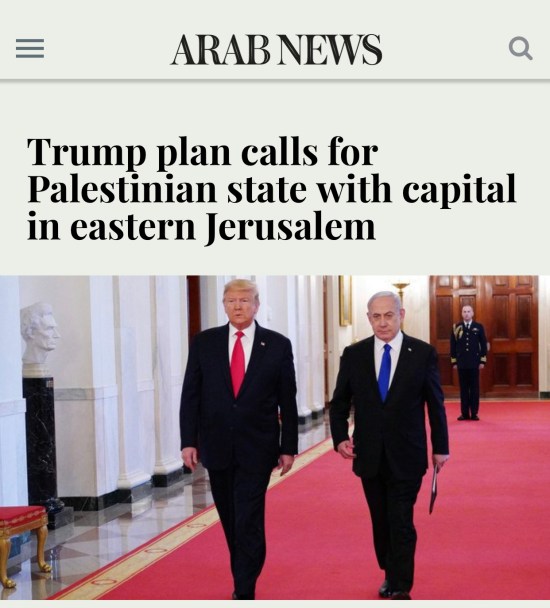
EXCLUSIVE: First Arab reaction. President unveils 181-page peace plan. Calls it “win-win.” Netanyahu raves. Three Arab ambassadors attend ceremony. Lots of controversy ahead. Here’s what you need to know.

EBAA2820-FBDA-4DB7-B86B-A4E723F8F150

UPDATED: (Jerusalem, Israel) — Historic. Dramatic. Highly controversial. And full of surprises. That’s how I’d characterize the roll out of the so-called “Deal of the Century.”

“All previous generations from Lyndon Johnson tried and bitterly failed,” the President said. “But I was not elected to do small things, or shy away from big problems.”

EXCLUSIVE — FIRST ARAB REACTION: Just received a text from a senior Arab Muslim official in the region who was watching the White House event live in his home country.

  • Called it a “very smart introduction to the Deal of the Century.”
  • Liked that President Trump is “mentioning the two states and sending a caring message to the Palestinians.”
  • Said “there is a need to gain the hearts and the minds of the general Palestinian people — they don’t see any future for themselves right now.”

UPDATE — MORE ARAB REACTIONS: 

  • Palestinian Authority: “We say 1,000 ‘no’s to this deal,” Palestinian Authority President Mahmoud Abbas said (Jerusalem Post)
  • Palestinians immediately began mobilizing against the plan, Reuters reports — thousands turning out on streets, rioting, burning flags and more.
  • And yet, Ambassadors from three Arab countries attended the White House ceremony (see below), and several Arab governments are speaking positively of the new U.S.-led peace effort.
  • Saudi Arabia: The Saudi Foreign Ministry Tuesday night released a quite positive statement on the White House peace plan. They thanked President Trump and his administration for their efforts to make peace between Israel and the Palestinians. They also urged the Palestinian leadership to take the plan seriously and return to direct negotiations. Based on my meetings with HRH Crown Prince Mohammed bin Salman and other senior Saudi officials in two trips to the Kingdom over the past 18 months, I am very encouraged by this initial response.
  • United Arab Emirates: Sent its Ambassador to the White House ceremony. Ambassador called the Trump peace plan a “serious initiative” that “offers an important starting point for a return to negotiations within a US-led international framework.”
  • Bahrain: Sent its Ambassador to the White House ceremony. “The Ministry of Foreign Affairs commends the United States of America for its determined efforts to advance the peace process, and expresses its aspiration for the parties concerned to study the plan put forward by the United States of America, and to begin direct negotiations under the auspices of the United States of America to reach an agreement that meets the aspirations of the Palestinian and Israeli people in achieving a comprehensive and just peace between them, which leads to the establishment of an independent Palestinian state and supports security and peace that benefits all states in the region and their people.”
  • Oman: Sent its Ambassador to the White House ceremony.
  • Egypt: “Egypt called on Tuesday on Palestinians and Israelis to carefully consider a peace plan announced by U.S. President Donald Trump, with a view to resuming negotiations,” Reuters reported. “Egypt calls on the two relevant parties to undertake a careful and thorough consideration of the U.S. vision to achieve peace and open channels of dialogue, under U.S. auspices, for the resumption of negotiations,” a statement from the foreign ministry said. (read full statement posted on Foreign Ministry’s Facebook page)
  • Morocco: Statement from Nasser Bourita, Minister of Foreign Affairs for the Kingdom of Morocco: “Morocco appreciates the peace efforts of the Trump Administration and wishes that a constructive peace process be launched . . . Already, Morocco has noted elements of convergence with the principles and options that it has always defended in this matter: These include the two-state solution.”
  • Kuwait: “Kuwait’s foreign ministry also said on Wednesday it ‘highly appreciates’ US efforts to ‘end the over-70-year Arab-Israeli conflict, that has caused bitter sufferings to the Palestinian people and undermined regional security and stability,’” reported Arab News.
  • Qatar: Even Qatar, which is an ally of Hamas and the Muslim Brotherhood, put out a statement of support. “The State of Qatar welcomes all efforts aiming towards a longstanding and just peace in the occupied Palestinian territories. It also appreciates the endeavors of President Trump and the current US administration to find solutions for the Palestinian-Israeli conflict, all solutions should be consistent with international law and the relevant UN resolutions.”

966B3587-8296-426E-A9C6-086216C2DEC5
(photo: Jason Greenblatt, one of the architects of the plan, with the Ambassadors of Oman, the UAE, and Bahrain)

Okay, some facts, then some analysis:

FACTS:

  1. Here’s the full 181-page plan — including first detailed maps ever released.
  2. President Trump called plan “win-win” with a “realistic” plan and pathway for “two states.” Called Israel a “light to the nations,” referencing Scripture. Said the Palestinian people deserve better than they have.
  3. President said Israel will control the Jordan Valley, keep all its settlements in Judea and Samaria and have “full security.” Said: “All humanity should be able to enjoy the glories of the Holy Land. This part of the world is forever connected to the human soul and the human spirit. These ancient lands should not be symbols of conflict, but eternal symbols of peace.”
  4. Israel gets a lot of Judea and Samaria (West Bank) — but the Palestinians are compensated with large new tracts of territory in the Negev, near Egyptian border. (see map)208E9257-EF14-4C68-8E64-7CD68B25178C
  5. Plan will create a Palestinian state which can be achieved if Palestinians “renounce terror” — won’t allow return to bombings and violence. Wants “very capable” Palestinians to have better lives, because “that’s only fair.”
  6. Called for 4-year freeze in Israel settlement activity, doubling of Palestinian territory.
  7. Jerusalem will be Israel’s undivided capital.
  8. However, President added Palestinians will have capital in East Jerusalem and U.S. will have Embassy there.
  9. President added that Jerusalem is already “liberated.” Said it’s “time for the Muslim world to fix the mistake it made in 1948 when it decided to attack Israel — it’s time.”
  10. U.S. and Arab states ready to invest $50 billion in new Palestinian economy to create jobs and hope.
  11. President worries this may be Palestinians “last chance” for state.
  12. President spoke highly of Jordan’s King Abdullah II — “a very good man” — with whom the U.S. wants to work. Added that U.S. will work to “maintain status quo” to “protect the holy sites,” including the Al-Aqsa Mosque.
  13. Even while speaking of Israel’s “rich Biblical history,” President Trump gave a warm and very special “thank you” to the ambassadors of Oman, Bahrain and the United Arab Emirates for coming to the unveiling the White House peace plan ceremony and for all they are doing to advance peace — this was historic for them to be there and very encouraging.
  14. Netanyahu fully endorsed the plan — raved about it, in fact. Said it will keep all Israelis safe. Said he’s ready to begin negotiations with Palestinian.
  15. Netanyahu stopped in mid-speech to give a shout-out to the ambassadors of the Gulf countries of Oman, Bahrain and the United Arab Emirates — men he clearly knows and has affection for — a dramatic and touching moment.

0DDE21C0-088E-4C65-968E-25B90B1828DBANALYSIS:

  • Excellent roll out event.
  • I was very happy that three Arab Ambassadors were there — two of whom are dear friends — and that Trump and Bibi gave them very warm and special shout-outs and that they received thunderous applause. Incredibly important.
  • Overall, most grassroots Evangelicals will be very happy because they trust Trump and because Bibi (and Gantz) are so positive about it.
  • However, some Evangelical leaders don’t want any Palestinian state whatsoever — one of them is Pastor John Hagee. Given that there are 8 million members in his Christians United For Israel, he’s a major player. Hagee and others will be unhappy about Palestinian capital in East Jerusalem, as well.
  • However, as I’ve been telling senior White House and State officials for months, these two points are vitally important. Why? Because there’s no chance Abbas accepts this deal — but including the two-state and East Jerusalem capital language makes it much easier for other Arab states to embrace the deal.

That’s enough for now. More later. Please keep praying for the peace of Jerusalem.

—————————

—————————

____________________

How will Evangelicals react to the Trump peace plan? How will Arab leaders react? I discussed these questions tonight on Israel’s i24 TV on the eve of the plan’s formal roll-out.

9A3AE8AD-BFFA-4335-94F2-13322C8D671C
(Jerusalem, Israel) — An historic week is underway. And a controversial one at that.

On Monday, President Trump met with Israeli Prime Minister Benjamin Netanyahu at the White House at 11am.

At 12:30pm, the President met with Israeli opposition leader Benny Gantz, the former IDF chief of staff who now leads Israel’s largest political party. Both are facing off in a third round of elections on March 2.

Trump privately briefed each leader on his long-awaited and much-debated “Deal of the Century.” He then announced that he will release his full Israeli-Palestinian peace proposal on Tuesday at noon eastern.

Tonight, I was interviewed live on the i24 TV news network here in Israel. The anchors and I focused on two critical questions: How will Evangelical Christians react to the plan? And how will Arab leaders react?

Here’s the link to the full interview. (It starts at 4:10 minutes into the segment.)

During the interview, I referenced a poll that we commissioned for a Christian group I helped found called the Alliance for the Peace of Jerusalem. Specifically, I cited numbers suggesting that not all Christians hold the same views about the peace process or the “two-state solution” as Christian leaders. To read the full poll in context, please click here. 

I’ll post more analysis when the plan is released. In the meantime, please keep both Israelis and Palestinians in your prayers — pray for peace and calm here and throughout the region, knowing that controversy over the plan could create its own new set of tensions. Thanks so much.

Vice President Pence delivered a powerful address at the World Holocaust Forum last week. But what really set it apart was his emphasis on the Bible and God’s faithfulness to the Jewish people. A few thoughts.

Pence-WesternWall

(Jerusalem, Israel) — At the World Holocaust Forum on Thursday, marking the 75th anniversary of the liberation of the Auschwitz death camp in southern Poland, Vice President Mike Pence gave a moving and powerful speech.

What touched me most was his oft citation of, and reference, to God and the Bible. No other speaker at the event took that approach.

Sadly, very few public officials here in Israel openly (much less frequently) cite the Holy Scriptures, even though the Bible was given to the world primarily through the Jewish people. How encouraging, then, that an American Evangelical Christian would gently and respectfully remind Israelis — and the leaders of 49 other nations who attended — of eternal truths most people, including mine, don’t often hear.

This was Mr. Pence’s second visit to Israel as V.P. — when he was here in January 2018, he addressed a full session of the Knesset. As I noted at the time, he “spoke of his personal affection for Israel and the Jewish people and cited or alluded to more Scripture than probably any foreign leader who has spoken there.” Indeed, the more I’ve thought about that speech, which I had the blessing of attending in person, I believe that Pence cited more Scripture than any Israeli ever to address the Knesset. 

I thank God for men of faith who are not afraid to discuss the most important and life-changing Book ever written.

A few excerpts from the V.P.’s wonderful address:

  • The word “remember” appears no fewer than 169 times in the Hebrew Bible — for memory is the constant obligation of all generations. And today we pause to remember what President Donald Trump rightly called the “dark stain on human history” — the greatest evil ever perpetuated by man against man in the long catalogue of human crime.
  • The faces of a million and a half children reduced to smoke under a silent sky for the crime of having a single Jewish grandparent.  The night Elie Wiesel called “seven times sealed” consumed the faith of so many then, and challenges the faith of so many still. Today we remember what happens when the powerless cry for help and the powerful refuse to answer….

Pence-Holocaust-speech

  • Today we remember not simply the liberation of Auschwitz but also the triumph of freedom — a promise fulfilled, a people restored to their rightful place among the nations of the Earth.  And we remember — we remember the long night of that past, the survivors and the faces of those we lost, the heroes who stood against those evil times.  And today we gather nearly 50 nations strong, here in Jerusalem, to say with one voice: Never again….
  • Through pogroms, persecutions, and expulsions in the ghettos, and finally, even through the death camps, the Jewish people clung to an ancient promise that He would “never leave you or forsake you” and that he would leave this people to inherit the land that he swore to your ancestors that he would give them….
  • And so, today, as we bear witness to the strength and the resilience and the faith of the Jewish people, so too we bear witness to God’s faithfulness to the Jewish people….

To read the full text, please click here. // To watch the speech, please click here.

—————————

—————————

____________________

BREAKING: Trump to unveil peace plan next week. Invites Netanyahu, Gantz to White House. Pence issues invitation while in Jerusalem. Palestinian leaders livid. High risk strategy. Here’s what we know so far.

62D60BE6-47D8-499F-B5D9-0DD41A96D39A

(Jerusalem, Israel) — Stunning most Mideast analysts and pundits, President Trump says he will unveil his “Deal of the Century” peace plan next week. And he will also host a high profile, high stakes meeting with two senior Israeli leaders at the White House on Tuesday.

“It’s a great plan,” the President said aboard Air Force One, heading to Florida. “It’s a plan that really would work.”

Here’s what we know at this hour:

  • Pence issued invitations to Netanyahu and opposition leader Benny Gantz while he was in Jerusalem on Thursday. (note: more details in the Pence visit tomorrow.)
  • Pence said Gantz was invited at the recommendation of Netanyahu.
  • Pence made the announcement while on his first visit to the new American Embassy in Jerusalem.
  • Pence is now the highest ranking American official to visit the new Embassy.
  • White House goal by including Gantz: to create the widest possible acceptance of the plan from across the Israeli political spectrum.
  • Jared Kushner and Avi Berkowitz — two of the architects of the plan — were supposed to be in Israel this week for the World Holocaust Forum that drew top leaders from 50 countries.
  • Both canceled their trip at the last moment. Media speculation suggested the cancellation meant the plan’s release wasn’t imminent. But just the opposite was true.
  • Leaks throughout the Israeli media purport to have bombshell details contained in the plan — but for the moment it’s all speculation and rumor.
  • Palestinian leaders are seething — one said, “No Palestinian can accept this dangerous conspiracy.”
  • A livid Mahmoud Abbas said: “We warn Israel and the U.S. administration not to cross any red lines.”
  • Very few of the 50 world leaders who came to Israel this week visited Abbas.
  • In a sad and likely self-defeating move they may come to regret, Palestinian leaders have for more than a year shut down all contact with the White House and have done nothing to negotiate with the Trump administration and try to improve how the deal may affect them.
  • Nevertheless, Trump says of his deal, “it’s actually very positive for them (the Palestinian people).

Three big questions emerging:

  • First, will the vast majority of the Israeli people embrace the plan, or will it create new social and political divisions?
  • Second, even though Abbas and his advisors will reject and denounce the plan, will any segment of the Palestinian people embrace it, or at least say that it is a reasonable starting point to begin negotiations?
  • Third, how will the Gulf Arab states react? Egypt? Jordan? I’m watching these matters most closely of all.

F89B0955-DE66-4582-91E7-4F1BB16C927A

“Some supporters of the U.S. administration’s broader Middle East policy are hesitant regarding the option of publishing it before the election,” the Israeli daily Haaretz reported on Wednesday, before this news broke late Thursday night.

“Joel Rosenberg, a Jerusalem-based author and analyst who has made headlines in recent years for organizing high-profile meetings between U.S. evangelical leaders and Arab heads of state, tells Haaretz he thinks it would be wiser to publish the plan after the election.”

“Is there an upside to releasing the peace plan before the Israeli election in March? Perhaps, but I don’t see it,” Rosenberg says. He adds that, in his opinion, it would be better “to put the plan out immediately after the March 2 vote, but before anyone puts together a coalition. That way, the White House can’t be accused of interfering in the election, but it can still lay on the table core principles and key proposals that a new Israeli prime minister will absolutely need to take into account.”

That said, having decided to plow ahead and release the plan now, I will say it was a shrewd move by Trump and Pence to invite Gantz to the White House for the rollout. That will help blunt (though by no means eliminate) accusations that the White House is trying to boost Bibi’s re-election efforts.

7C00E41E-ED11-43E8-AE52-457D5F3371D0
Next week promises to be fascinating, controversial and historic. I’ll provide updates and analysis from here in Jerusalem on this blog. For up-to-minute-updates, please follow me on Twitter.

—————————

—————————

____________________

BREAKING: Senior Saudi Muslim leader set for “groundbreaking” visit to Auschwitz Thursday. Historic moment in faith diplomacy. (Honored to be quoted in a must-read Times of Israel article.)

1295E79B-DD3F-430F-93FC-C9B6E27D6306

(Jerusalem, Israel) — In an historic moment in what I call “faith diplomacy,” the top Muslim religious leader in the Kingdom of Saudi Arabia will visit the Auschwitz-Birkenau death camp in southern Poland for the first time on Thursday.

He will also participate a delegation of Muslim and Jewish leaders commemorating the liberation of Auschwitz 75 years ago this week.

The cleric’s name is Sheikh Mohammad Al-Issa, head of the Muslim World League in Riyadh.

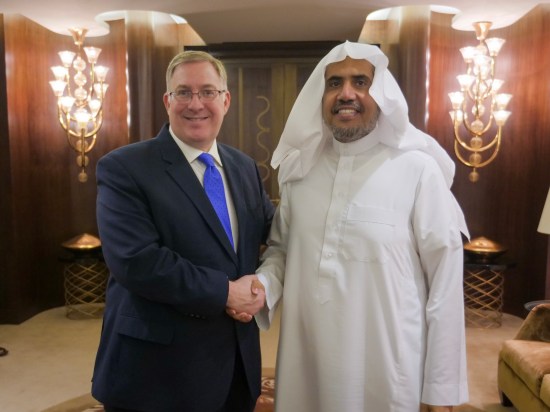
I have met the Sheikh several times during my past two visits to the Kingdom and have spent many hours in dialogue with him. My Evangelical Delegation colleagues and I consider him a true friend who is genuinely interested in respectful inter-faith relations and advancing moderate Islam.

The Times of Israel has just published an excellent article previewing the Sheikh’s visit and quoting several experts on why it is significant.

“Joel Rosenberg, an Evangelical Christian and an American-Israeli author who has met with Issa twice in Saudi Arabia, said that he believed the Saudi religious leader has the backing of the Riyadh’s leadership to make the trip to Auschwitz,” the Times reported.

“He definitely would not be making this visit if the crown prince did not want him to do so,” Rosenberg said in a phone call, referring to Issa as in the “close orbit” of Prince Mohammed.

I commend the full story to your attention.

Let’s pray this trip helps 1.6 billion Muslims around the world learn more about the Holocaust, Jewish history and the importance of a sovereign and strong State of Israel. Let’s pray, too, that the Sheikh and his colleagues will one day be able to accept my invitation to come visit the Jewish, Christian and Muslim holy places here in Jerusalem and throughout the Land of Israel.

—————————

—————————

____________________